Leap.Solutions is loading
Common Problems

Challenges we're regularly asked to solve

High chemical cost per kg

No clear breakdown of avoidable waste versus true process requirement.

Inconsistent quality

Shade variation, grain issues, softness and finish problems batch to batch.

Yield loss

Avoidable losses from process variation and unmeasured handling problems.

Technical team gaps

Production and lab teams needing structured coaching, SOPs and mentoring.

Services

Nine ways we help tanneries improve

Structured review of production, recipes, process controls, chemical consumption, yield, quality, bottlenecks, documentation and team practices.

Beamhouse, tanning, wet-end and finishing process review; recipe rationalization; process-window definition; standardization and trial planning.

Chemical consumption, water, energy, reprocessing, rejection, labor productivity, yield and process-loss analysis.

Identification of avoidable yield losses, process variation and handling problems; measurement framework and improvement plan.

Root-cause analysis for defects, shade variation, physical performance, grain issues, softness, fullness, finish and customer complaints.

Practical SOPs, production checklists, laboratory controls, shift reporting and management dashboards and KPI routines.

On-the-job coaching, technical reviews, structured training and mentoring for production and laboratory teams.

Water and chemical reduction, process efficiency, resource monitoring and preparation for customer sustainability expectations.

Data capture, digital process records, dashboards and future AI-assisted troubleshooting and decision-support systems.
Benefits

What a structured program delivers

  • Lower chemical, water and energy cost per unit of leather produced.
  • More consistent quality with fewer rejections and reworks.
  • Measured yield improvement against an agreed baseline.
  • Stronger production and laboratory teams with durable SOPs and KPI routines.
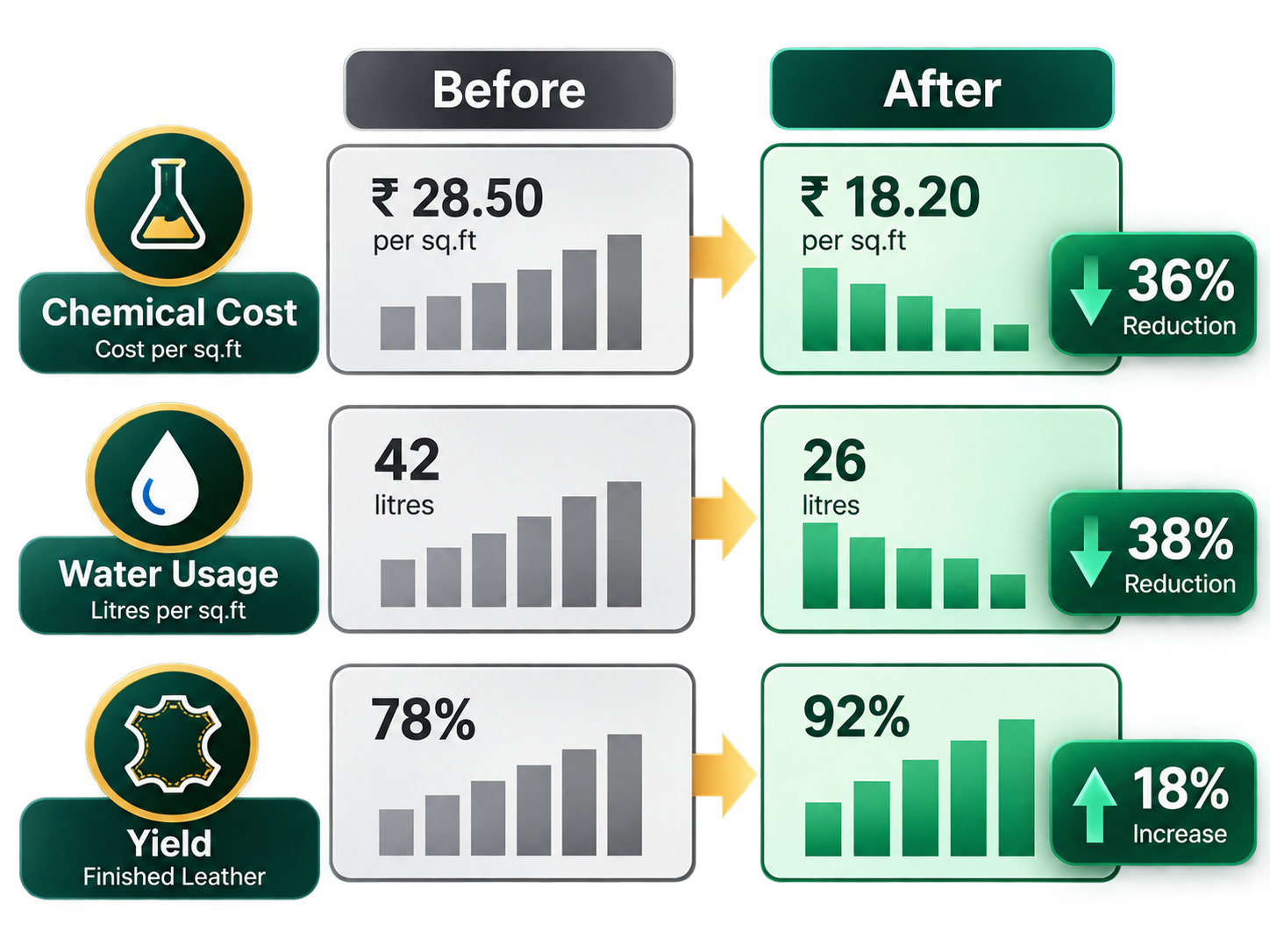
Before and after chart of chemical cost, water use and yield at a tannery
Before/After Performance Chart
Methodology

The same disciplined process, every time

1
Discover
2
Diagnose
3
Baseline
4
Design
5
Implement
6
Measure
7
Stabilize
8
Review
1
Discover

Understand the business problem and desired outcome.

2
Diagnose

Collect data, interview relevant staff and identify root causes.

3
Baseline

Establish current performance with measurable KPIs.

4
Design

Create technical and commercial improvement actions.

5
Implement

Conduct trials, train teams and deploy agreed changes.

6
Measure

Compare results against baseline.

7
Stabilize

Document SOPs, controls and ownership.

8
Review

Present results and recommend the next improvement cycle.

FAQ

Frequently asked questions

Can't find your question? Get in touch directly.

Not always. Smaller, well-defined problems can start directly with a remote diagnostic or a focused Cost Reduction Sprint. A full Factory & Process Audit is recommended when the problem spans multiple process stages or isn't yet clearly defined.

We quote after a short qualification call, based on scope, duration, complexity and the number of experts required — not from a generic published price list.

A Leap.Solutions project lead owns every engagement, supported where needed by vetted members of the Leap Expert Network. Client contracting, scope, quality control and invoicing remain with Leap.Solutions throughout.

Every project begins with a documented baseline (e.g. chemical cost per kg, water per kg, yield, rejection/rework rate) so improvements can be measured objectively at review.